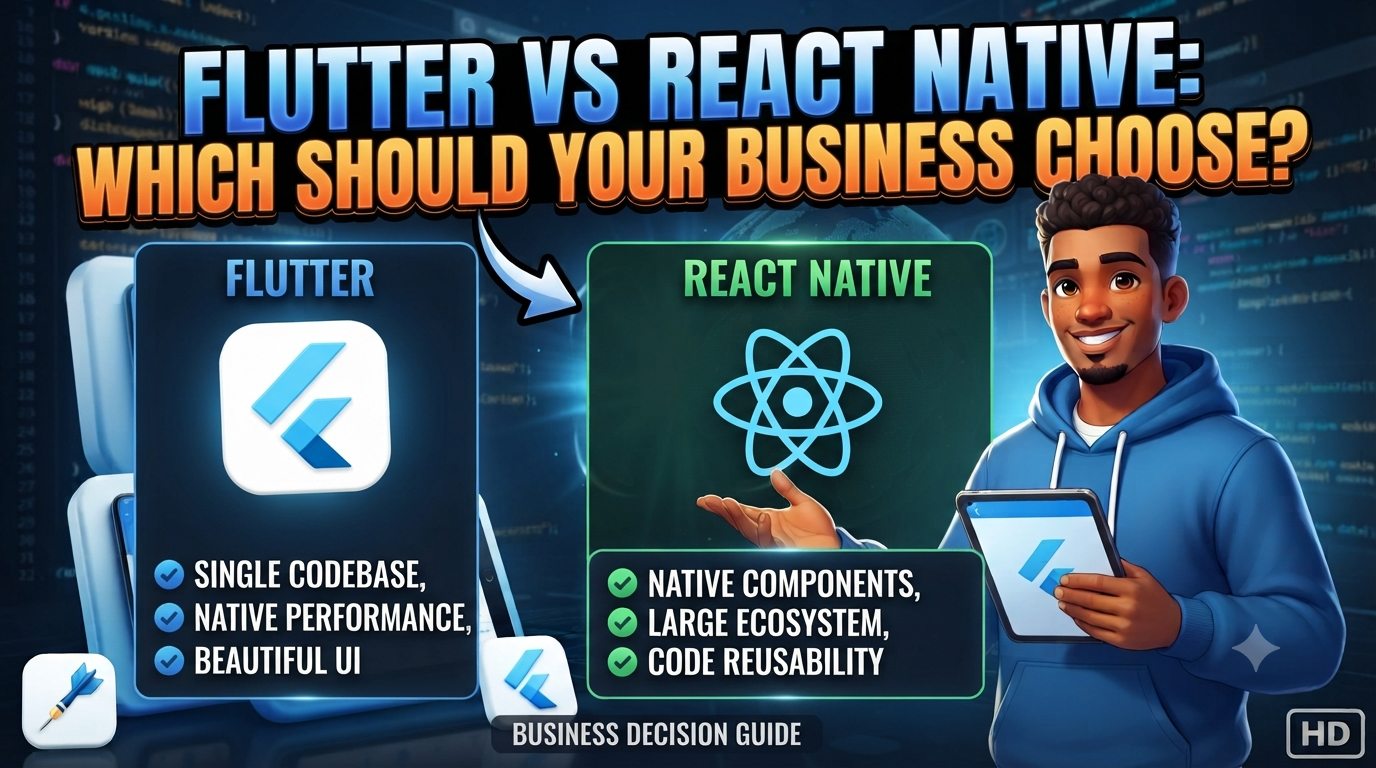
Navigating Flutter vs React Native? This in-depth guide helps businesses choose the best cross-platform framework for their mobile app development based on performance, cost, and future needs.
Introduction: Navigating the Cross-Platform Mobile Maze 🚀
In today's fast-paced digital world, a robust mobile presence is non-negotiable for businesses aiming to connect with their audience. The quest for efficiency often leads companies to cross-platform mobile app development – a method that allows a single codebase to run on both iOS and Android. Among the frontrunners in this space are Flutter, backed by Google, and React Native, championed by Facebook.
Choosing between these two formidable frameworks can be a critical decision that impacts your project's budget, timeline, performance, and long-term maintainability. This comprehensive guide will dissect Flutter and React Native, helping your business make an informed choice.
Understanding Flutter: Google's UI Toolkit ✨
Flutter is an open-source UI software development kit created by Google. It allows you to build natively compiled applications for mobile, web, and desktop from a single codebase. Flutter uses Dart as its programming language, which is known for its efficiency and strong typing.
Flutter's Strengths for Businesses ✅
- Exceptional Performance: Flutter compiles directly to native ARM code, leading to near-native performance and smooth animations (60-120 fps).
- Stunning UI/UX: With its rich set of customizable widgets and Skia graphics engine, Flutter offers unparalleled control over UI, enabling pixel-perfect, branded experiences.
- Single Codebase, Multiple Platforms: True code reuse across iOS, Android, web, and desktop significantly reduces development time and cost.
- Hot Reload & Hot Restart: Speeds up development cycles by allowing developers to instantly see changes without losing the app's current state.
Flutter's Considerations for Businesses 🚧
- Larger App Size: Flutter apps can sometimes have a slightly larger file size due to bundling all necessary widgets and runtimes.
- Dart Learning Curve: While Dart is relatively easy to learn, it might be a new language for many developers, potentially extending initial ramp-up time.
- Younger Ecosystem: Although rapidly growing, Flutter's plugin and package ecosystem is still smaller compared to React Native's mature offerings.
💡 Pro Tip: Flutter is ideal if your business prioritizes bespoke, high-performance UI and is comfortable with a slightly newer ecosystem. Think visually rich apps and brand-specific designs.
Understanding React Native: Facebook's JavaScript Powerhouse 🌐
React Native is an open-source mobile application framework created by Facebook. It allows developers to use JavaScript and React to build native mobile apps. Leveraging the popular React ecosystem, React Native bridges JavaScript code to native UI components, giving apps a native look and feel.
React Native's Strengths for Businesses ✅
- JavaScript Familiarity: If your team already has web developers proficient in JavaScript and React, the learning curve for React Native is significantly lower.
- Mature Ecosystem & Community: React Native benefits from the vast and active JavaScript community, offering a wealth of libraries, tools, and developer support.
- Faster Development Cycles: Features like 'Hot Reloading' and a declarative UI approach contribute to quicker iteration and development.
- Code Reusability: Share a significant portion of code between iOS and Android, reducing development effort.
React Native's Considerations for Businesses 🚧
- Potential Performance Bottlenecks: While generally good, performance for complex animations or computation-heavy tasks can sometimes be less fluid than Flutter, as it relies on a JavaScript bridge.
- Dependency on Native Modules: For highly specific device features, developers might need to write native code (Objective-C/Swift for iOS, Java/Kotlin for Android), increasing complexity.
- Fragmented UI: While it uses native components, achieving a truly consistent look and feel across platforms can sometimes require more effort due to platform-specific styling.
💡 Pro Tip: React Native is a strong contender if your business has an existing JavaScript/React web development team or needs rapid prototyping and a wide array of existing libraries.
Key Comparison: Flutter vs React Native for Business Decisions 🎯
Performance & User Experience (UX)
Flutter: Generally offers superior performance due to direct compilation to native code and rendering everything using its own Skia engine. This translates to smoother animations and a more consistent UI across devices, providing an excellent user experience.
React Native: Performance is good for most standard applications, but can occasionally hit bottlenecks with complex animations or heavy calculations due to the JavaScript bridge. The UX is generally native-like as it uses native UI components.
UI Development & Customization
Flutter: Uses widgets that are part of the framework itself, offering immense control over the UI. Developers can create highly custom, pixel-perfect designs that look identical on every platform. This is great for strong brand identity.
React Native: Renders actual native components. While this provides a native feel, achieving a truly uniform, custom UI across platforms might require more workarounds or third-party libraries. It’s excellent for standard native look and feel.
Development Speed & Cost
Flutter: With features like Hot Reload, a single codebase, and rich widget catalog, Flutter can significantly speed up development and reduce overall costs. The declarative UI also makes complex UIs easier to build.
React Native: Hot Reloading and the ability to leverage existing JavaScript skills also contribute to rapid development. Its mature ecosystem means many common functionalities can be quickly implemented using existing packages, potentially saving time.
Community & Ecosystem
Flutter: Has a rapidly growing and passionate community, and Google is continuously investing in its development. The ecosystem for packages and libraries is expanding quickly.
React Native: Benefits from the massive JavaScript community. It has a larger, more mature ecosystem with a vast array of open-source libraries, tools, and readily available talent.
Learning Curve & Talent Availability
Flutter: Requires learning Dart, which can be a hurdle for teams without prior experience. However, Dart is modern and easy to pick up for developers familiar with C-style languages. Finding experienced Flutter developers can be slightly more challenging than React Native talent.
React Native: The learning curve is gentler for developers already proficient in JavaScript and React. The larger talent pool for React Native can make hiring easier and potentially more cost-effective.
When to Choose Flutter for Your Business 🎯
- Your business aims for a highly custom, pixel-perfect UI/UX that needs to look identical across all platforms.
- Performance and smooth animations are critical for your app's core functionality (e.g., gaming, complex animations, high-fidelity data visualization).
- You're starting a new project and are open to adopting a new language (Dart) for long-term benefits.
- You value strong official support from Google and a rapidly evolving framework.
- You have a smaller team and need maximum code reuse across mobile, web, and desktop.
When to Choose React Native for Your Business 🎯
- Your development team already has strong expertise in JavaScript and React.
- You need to build an MVP (Minimum Viable Product) quickly and cost-effectively, leveraging existing web components.
- The app relies heavily on standard native UI components and doesn't require extensive custom design.
- You prioritize access to a vast, mature ecosystem of libraries and a large community for support.
- You're building an app where integration with existing native modules might be a common requirement.
Conclusion: The Best Choice is Your Business's Choice 🤔
Both Flutter and React Native are powerful, feature-rich frameworks capable of delivering high-quality cross-platform mobile applications. There's no single "winner" in this debate; the optimal choice heavily depends on your specific business goals, team's existing skill set, budget, timeline, and the desired user experience.
💡 Final Insight: Before making a decision, conduct a thorough analysis of your project's requirements, including performance needs, UI complexity, existing team skills, and long-term maintenance strategy. Consider building small prototypes with both technologies to experience their workflows firsthand.
Whether you lean towards Flutter's elegant UI and native performance or React Native's JavaScript prowess and mature ecosystem, selecting the right framework will set the foundation for your app's success. Choose wisely, and empower your business in the mobile-first world!