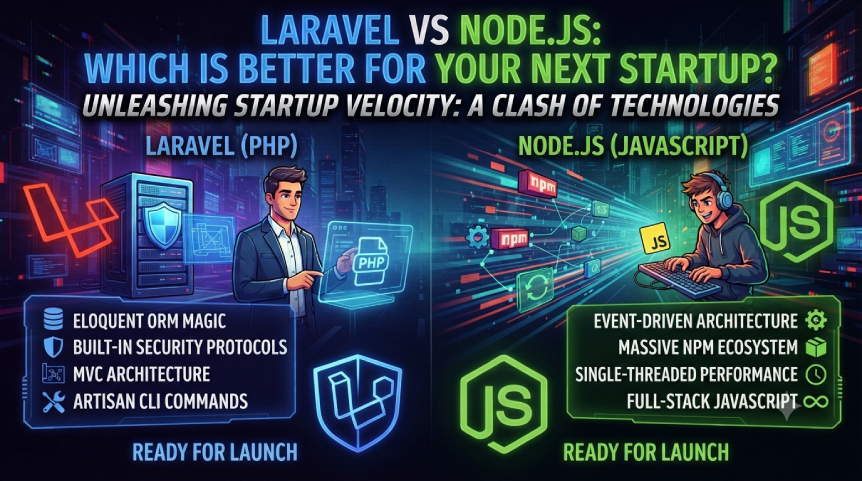
Deciding between Laravel (PHP) and Node.js (JavaScript) for your startup? Explore performance, scalability, development speed, and community support to make an informed choice.
Introduction: The Startup Tech Dilemma 💡
Choosing the right technology stack is one of the most critical decisions for any startup. It impacts everything from development speed and scalability to team hiring and long-term maintenance. In the vast landscape of web development, two giants often come into play for backend development: Laravel (PHP) and Node.js (JavaScript).
Why This Choice Matters
The foundation you build your startup on will dictate its agility and ability to adapt. A wrong choice can lead to bottlenecks, higher costs, and missed market opportunities. Let's dive deep into both to help you make an informed decision.
Laravel: The PHP Powerhouse 💪
Laravel is a free, open-source PHP web framework, famous for its elegant syntax and developer-friendly features. It aims to make web development a joyful and creative experience.
Speed of Development
Laravel excels in rapid application development. Its rich ecosystem, extensive documentation, and numerous pre-built components (like authentication, ORM, queues) allow developers to build complex applications quickly. This is crucial for startups needing to launch an MVP (Minimum Viable Product) fast.
Ecosystem and Community
PHP has a massive, mature community, and Laravel is its undisputed king. You'll find abundant resources, packages (via Composer), tutorials, and support forums. This robust ecosystem significantly reduces development time and troubleshooting efforts.
Performance and Scalability
While often stereotyped as slow, modern PHP and Laravel, when configured correctly, offer excellent performance. With tools like Redis, queues, and proper caching, Laravel applications can scale effectively to handle significant traffic. It's perfectly suitable for most web applications, including e-commerce and SaaS platforms.
Use Cases for Laravel
- Content Management Systems (CMS): Blogs, news sites, administrative panels.
- E-commerce Platforms: Building online stores with robust backend logic.
- SaaS Applications: Many subscription-based services find Laravel ideal for their backend.
- Rapid Prototyping: Quickly bringing ideas to life with an MVP.
Pro-Tip: Laravel is excellent for rapid prototyping and content-heavy applications where time-to-market is crucial. Its developer-friendly features reduce complexity.
Node.js: The JavaScript Everywhere Solution ⚡
Node.js is a JavaScript runtime built on Chrome's V8 JavaScript engine. It allows developers to use JavaScript for server-side code, bringing a unified language stack to both frontend and backend development.
Performance and Real-time Capabilities
Node.js is renowned for its non-blocking, event-driven I/O model, which makes it incredibly efficient for handling many concurrent connections. This is a huge advantage for real-time applications like chat apps, live dashboards, and online games.
Scalability and Microservices
Its lightweight nature and ability to handle high concurrency make Node.js a strong candidate for building scalable microservices architectures. It can effectively distribute workloads across multiple servers, making it highly adaptable to fluctuating demands.
Ecosystem and Community
The Node.js ecosystem, powered by npm (Node Package Manager), is vast and growing rapidly. With millions of packages available, finding a solution for almost any problem is straightforward. The community is vibrant, especially within the JavaScript developer landscape.
Use Cases for Node.js
- Real-time Applications: Chat applications, online gaming, collaboration tools.
- APIs and Microservices: Building fast, scalable APIs that serve various frontends.
- Data Streaming: Processing large amounts of data in real-time.
- Single Page Applications (SPAs): Often paired with frontend frameworks like React, Angular, or Vue.
Pro-Tip: Node.js shines in applications requiring high concurrency, real-time data, and an isomorphic JavaScript stack. It's ideal for I/O-bound operations.
Laravel vs Node.js: Head-to-Head Comparison 🥊
Development Speed
- Laravel: Generally faster for feature-rich web applications due to its comprehensive framework, conventions, and built-in tools.
- Node.js: Can be fast for simple APIs or real-time features, but often requires more manual setup and integration of libraries, which might take more time for a full-stack web app compared to Laravel.
Performance and Scalability
- Laravel: High performance for typical web requests, scalable for most applications with proper optimization and caching.
- Node.js: Exceptional performance for I/O-bound operations and real-time interactions, highly scalable for concurrent connections and microservices.
Learning Curve
- Laravel: Relatively easy to learn for developers with PHP experience, and even beginners find its documentation and syntax approachable.
- Node.js: Easier for JavaScript developers, but the asynchronous nature and event loop can be a steeper learning curve for those new to the paradigm.
Ecosystem and Community Support
- Laravel: Mature, well-established, and very supportive community. Rich ecosystem of packages.
- Node.js: Massive, rapidly growing, and highly innovative community. Enormous npm package registry.
Cost of Development
- Laravel: PHP developers are generally abundant and can be more cost-effective to hire in some regions.
- Node.js: JavaScript full-stack developers are in high demand and might command higher salaries, but a unified language stack can streamline development.
Making Your Decision: What to Consider 🤔
The 'better' choice isn't universal; it's situational. Here are key factors your startup should evaluate:
- Project Type and Requirements: Does your app heavily rely on real-time communication, like a chat app or a gaming platform? Node.js might be a natural fit. Is it a content-heavy CRM or a sophisticated e-commerce platform? Laravel could be ideal.
- Team Expertise: What does your current development team know best? Leveraging existing skills can significantly accelerate development. If your frontend is already in JavaScript, a Node.js backend can streamline hiring and communication.
- Scalability Needs: How many users do you anticipate? What kind of load will your application experience? Both can scale, but their scaling patterns and strengths differ.
- Time-to-Market: How quickly do you need to launch your MVP? Laravel's batteries-included approach often offers a quicker path to a functional product.
- Budget: Consider the cost of hiring developers, infrastructure, and ongoing maintenance.
Conclusion: There's No One-Size-Fits-All Answer ✨
Both Laravel and Node.js are powerful, modern, and widely adopted technologies capable of building successful startup products. Your choice should align with your specific business goals, technical requirements, and team's strengths.
If you prioritize rapid development, a comprehensive framework, and a stable, mature ecosystem for typical web applications, Laravel is an excellent choice. If your startup thrives on real-time features, high concurrency, and a unified JavaScript stack, then Node.js will serve you exceptionally well.
The "better" choice depends entirely on your specific startup's needs, team's strengths, and project goals. Both are robust, proven technologies. Don't fear picking either, just make sure it aligns with your vision!